
When people hear about Traditional Chinese Medicine (TCM), weight loss is rarely the first thing that comes to mind. Yet for centuries, TCM has been used to help people regulate appetite, digestion, energy, and stress. All of these play a quiet but important role in weight management.
There is no single method in TCM for weight loss. It is usually a combination of therapies, lifestyle guidance, and dietary support, adapted to the individual rather than applied as a standard formula.
How Traditional Chinese Medicine Sees Weight Gain
In Traditional Chinese Medicine, weight gain is viewed as a sign that certain internal systems are not working in harmony. So, it focuses on understanding why the body may be holding on to weight, like:
- Weak digestive function – food and fluids are not efficiently processed
- Excess fluid accumulation – the body, often felt as bloating or heaviness
- Stress and emotional imbalance – strain affects appetite and metabolism
- Low energy levels – reduced movement and motivation
- Poor sleep – disrupted hormonal and digestive rhythms
Important Note
TCM does not replace modern medical understanding. It adds another layer that helps explain why weight loss can feel difficult even when someone is eating carefully and exercising regularly.
7 Common Chinese Therapies Used for Weight Management
Traditional Chinese therapies for weight management focus on restoring internal balance, improving metabolism, and supporting healthy digestion. By addressing the root causes of weight gain, these holistic treatments promote sustainable and natural weight loss.
1. Traditional Chinese Herbs for Weight Loss
Includes: Individual herbs, herbal formulas, and custom prescriptions based on diagnosis.
Best used when: Digestion feels weak, weight gain is accompanied by fatigue, bloating, or irregular appetite.
There’s no generic weight loss formula. Chinese herbal medicines are personalised as per the patient’s needs. As per their unique digestion, energy levels, stress patterns, and overall constitution.
Accordingly, they may aim to improve digestion, reduce bloating, support metabolic function, or help regulate appetite.
List of Chinese Herbal Medicines and Their Benefits
| Herb Name | Common Name | Why It’s Used | Who It’s Often Helpful For |
|---|---|---|---|
| Fu Ling | Poria mushroom | Helps reduce bloating and water retention | People who feel heavy, puffy, or bloated |
| Shan Zha | Hawthorn berry | Supports digestion, especially after heavy meals | Those who feel full or uncomfortable after eating |
| Bai Zhu | Atractylodes root | Strengthens digestion and reduces sluggishness | People with weak digestion and low energy |
| Chen Pi | Aged orange peel | Reduces bloating and helps balance appetite | Those with gas, bloating, or irregular appetite |
| Yi Yi Ren | Coix seed (Job’s tears) | Supports fluid balance and digestion | People prone to puffiness or water retention |
| Huang Qi | Astragalus root | Supports energy and metabolism | Fatigue, low stamina, slow progress |
| He Ye | Lotus leaf | Traditionally used for heaviness and fat metabolism | Feeling heavy or sluggish |
| Ze Xie | Alisma root | Helps the body release excess fluid | Swelling or fluid retention |
| Jue Ming Zi | Cassia seed | Supports bowel regularity | Constipation or slow digestion |
| Dang Shen | Codonopsis root | Supports energy during weight loss | Low energy while dieting |
| Gou Qi Zi | Goji berry | Supports balance and nourishment | Weakness or depletion during weight loss |
| Rou Gui | Cinnamon bark | Warms digestion and supports circulation | Cold sensitivity, slow digestion |
Disclaimer: This table is for education only. These herbs are usually combined into personalised formulas and should not be taken without professional guidance.
2. Acupuncture and Ear Acupuncture
Includes: Body acupuncture and ear-based techniques aimed at regulating appetite, stress response, digestion, and sleep.
Best used when: Cravings, emotional eating, stress, or poor sleep interfere with weight management.
Acupuncture is commonly used to support weight loss by helping regulate appetite, digestion, stress, and sleep. Whereas, ear acupuncture and ear acupressure focus on points on the ear that correspond to appetite, stomach, endocrine system, and emotional balance.
It reduces cravings or emotional eating and improves energy or gut comfort. These techniques are not about forcing weight loss but about helping the body respond more appropriately to food and stress.
3. TCM Food Therapy
Includes: Dietary guidance focused on improving digestion through warm, regular, and easily digestible meals.
Best used when: Weight concerns are linked to bloating, irregular meals, or sensitivity to certain foods.
TCM food therapy is a core part of ancient Chinese remedies and plays a major role in weight management. Instead of focusing on strict calorie control, it emphasises how well the body digests and uses food.
TCM food therapy is not about restricting or eliminating entire food groups. It is about choosing foods that suit your body and adjusting eating habits in a way that feels sustainable.
Common principles include eating warm, cooked meals, maintaining regular meal times, avoiding excessive cold or raw foods, and choosing foods that support digestion. This approach often aligns well with modern nutritional advice, even though the language used is different.
4. Moxibustion (Heat Therapy)
Includes: Gentle heat applied to specific points to support digestive warmth and circulation.
Best used when: The body feels cold, sluggish, or low in energy, with slow digestion.
Burning moxa (dried mugwort) over specific points or areas, Moxibustion provides warmth to areas linked with digestion, helping stimulate circulation and improve digestive function.
Many patients report feeling less bloated, warmer, and more energised after treatment. This improved comfort can make it easier to eat regularly, move more, and maintain healthy routines.
5. Cupping Therapy
Includes: Suction-based therapy used to stimulate circulation and relieve stagnation.
Best used when: Weight gain associated with heaviness, tension, or poor circulation, alongside other therapies.
From a TCM perspective, some people experience weight gain alongside poor circulation or stagnation. Cupping therapy is used to support circulation, reduce a feeling of heaviness in the body, and ease areas of tension that may affect movement and comfort.
While it is not a standalone solution for removing fat or promoting weight loss, cupping is typically used in conjunction with acupuncture, dietary changes, and lifestyle guidance. It works as a supportive therapy, not a standalone solution, and fits best into a broader, balanced weight management plan.
6. Tuina Massage and Acupressure
Includes: Therapeutic massage and targeted pressure on acupuncture points to support digestion and reduce stress.
Best used when: Digestive discomfort, tension, or stress-related eating patterns are present.
Tuina is a form of traditional Chinese therapeutic massage that works on muscles, joints, and specific pressure points. Acupressure uses steady finger pressure on the same points used in acupuncture, but without needles.
Tension, poor circulation, and stress can interfere with digestion and appetite regulation. Tuina helps relax the body and stimulate areas linked with digestive function. Acupressure may also help people become more aware of hunger and fullness cues, especially when stress or emotional eating is involved.
7. Qigong and Tai Chi
Includes: Gentle movement practices combining breath, posture, and mindful motion.
Best used when: Fatigue, stress, or joint discomfort make intense exercise difficult.
Qigong and Tai Chi are gentle movement practices that combine slow physical movement with breathing and mental focus. They may not burn large amounts of calories, but they help improve consistency, energy levels, and stress regulation.
When practiced regularly, Qigong and Tai Chi support weight management by helping people move more consistently, manage stress better, and stay connected to their bodies.
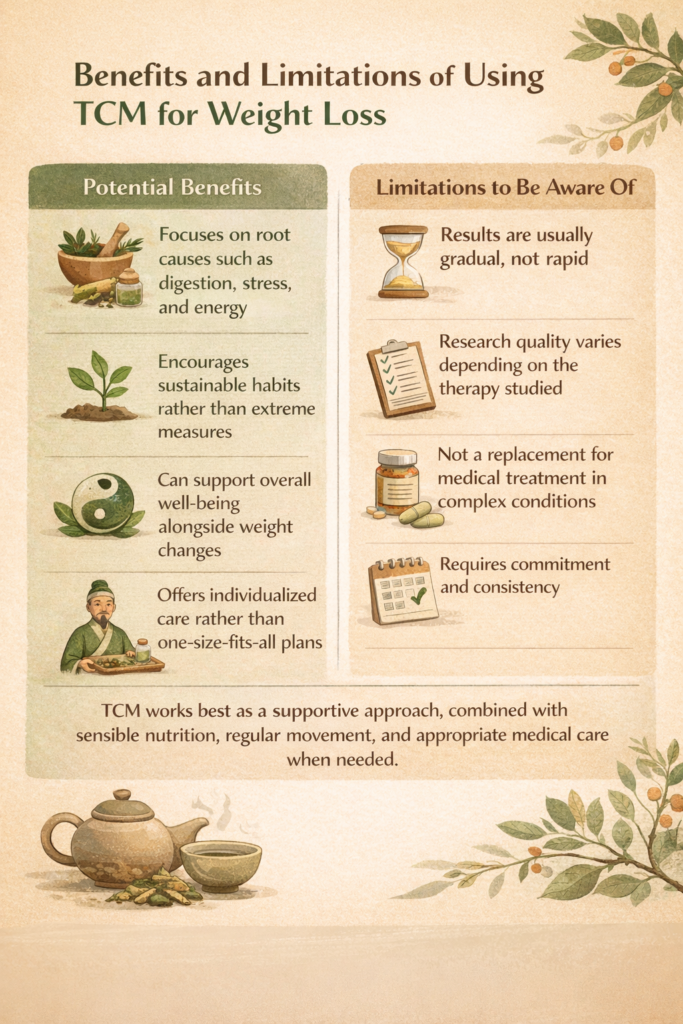
Benefits and Limitations of Using TCM for Weight Loss
What Patients Should Know About Chinese Therapies for Weight Management
- These therapies do not directly burn fat, but support digestion, energy, stress, and fluid balance.
- Weight changes happen gradually, not overnight.
- Chinese herbs are not weight-loss pills and should only be taken under professional guidance.
- Chinese medicine works alongside, not instead of:
- Healthy eating
- Regular movement
- Good sleep
- Stress management
- Always inform your practitioner about medications or medical conditions.
- Consistency matters more than intensity
Conclusion
Chinese therapy for weight loss offers a different way of thinking about the body. Instead of battling weight through restriction and pressure, it focuses on restoring balance so the body can function more efficiently.
It is best viewed as a supportive framework rather than a quick fix. It can help remove internal obstacles that make weight loss difficult, but it works most effectively when combined with sensible eating, regular movement, and appropriate medical care.
For people seeking a gentler, more individualised approach, TCM may offer meaningful support. For those looking for fast results or single-solution answers, it may not meet expectations.
Weight loss isn’t one-size-fits-all.
That’s why we personalize every wellness plan. From digestion and balance to long-term health, we help you move forward with clarity and care.
FAQs: Common Questions and Misconceptions About Chinese Therapies
Does acupuncture burn fat?
No. Acupuncture does not directly burn fat. It may help regulate appetite, stress, digestion, and sleep, which can support weight loss efforts.
Can I lose weight using Chinese herbs alone?
Chinese herbs are not magic pills. They work best when combined with dietary changes, movement, and lifestyle adjustments.
Is TCM safe for everyone?
TCM is generally safe when practiced by qualified professionals. Herbal medicine should always be prescribed with awareness of existing medical conditions and medications.
How long does it take to see results?
Some people notice changes in digestion or energy within weeks. Weight changes often take longer and vary from person to person.
Can TCM replace diet and exercise?
No. TCM is most effective when used alongside healthy eating and regular movement.
About Author
