
Introduction
Written by Dr Alicia Alaujo
Ever notice how your energy naturally rises and falls throughout the day? Some hours you feel sharp and productive, while others you crave rest, food, or quiet time. According to Traditional Chinese Medicine (TCM), this isn’t random—it reflects your body’s internal rhythm, often called the Chinese Body Clock.
This ancient system aligns closely with what modern science now calls the circadian rhythm—your natural 24-hour body clock that influences sleep, digestion, hormones, metabolism, and energy. When you understand this rhythm and work with it, you can support better health, deeper sleep, improved digestion, and more consistent energy throughout the day.
What Is the Chinese Body Clock?
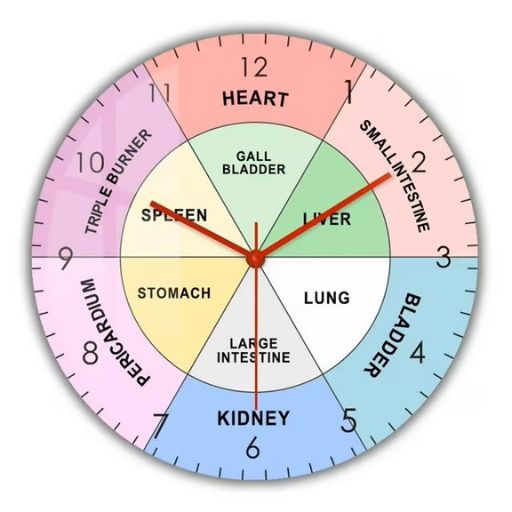
In TCM, Qi (your vital energy) moves through different organ systems in a predictable 24-hour cycle. Each organ has a 2-hour window of peak activity, when its functions are believed to be strongest.
Rather than viewing organs only through a Western medical lens, TCM sees them as part of broader systems that influence emotions, energy, digestion, circulation, and resilience.
The Full TCM Body Clock Rhythm
- 3–5am – Lung: Deep sleep, dreaming, breath regulation
- 5–7am – Large Intestine: Wake, hydrate, eliminate
- 7–9am – Stomach: Best time for a nourishing breakfast
- 9–11am – Spleen: Digestion and mental clarity peak
- 11am–1pm – Heart: Circulation, connection, joy
- 1–3pm – Small Intestine: Nutrient absorption and sorting
- 3–5pm – Bladder: Hydration and energy output
- 5–7pm – Kidney: Restore energy, gentle movement
- 7–9pm – Pericardium: Relaxation, connection, winding down
- 9–11pm – Triple Burner (San Jiao): Hormonal balance, preparation for sleep
- 11pm–1am – Gallbladder: Decision-making, tissue repair
- 1–3am – Liver: Detoxification, emotional processing
Why Eating to Your Circadian Rhythm Can Help
One of the most powerful ways to improve your health is to eat in sync with your body clock.
Modern research shows your metabolism, insulin sensitivity, digestive enzymes, and gut function are stronger earlier in the day. This means your body often handles food more efficiently in the morning and daytime than late at night.
In TCM, this matches the idea that the Stomach (7–9am) and Spleen (9–11am) are strongest in the morning, making breakfast and earlier meals ideal for nourishment and energy production.
Benefits of Eating Earlier in the Day
When you align meals with your circadian rhythm, you may experience:
- Better digestion
- More stable blood sugar levels
- Improved energy
- Reduced cravings
- Better sleep quality
- Healthier weight management
- Improved gut health
- Balanced hormones
Research into time-restricted eating and circadian nutrition suggests that eating earlier and avoiding late-night meals may support metabolic health and reduce inflammation.
Practical Meal Timing Tips
Try these simple shifts:
- Eat breakfast within 1–2 hours of waking
- Make lunch your largest meal if it suits your lifestyle
- Eat dinner earlier where possible
- Avoid heavy meals late at night
- Leave 2–3 hours between dinner and bedtime
- Eat consistently at similar times each day
Small changes can create powerful long-term benefits.
Signs You May Be Out of Sync With Your Body Clock
When we push against our natural rhythm—through late nights, irregular meals, stress, or overstimulation—the body may respond with symptoms such as:
- Afternoon fatigue
- Poor digestion
- Bloating
- Brain fog
- Restless sleep
- Waking between 1–3am
- Sugar cravings
- Hormonal imbalances
- Low motivation
These signs don’t mean something is “wrong”—they may simply indicate your body needs support and better rhythm.
How to Reset Your Natural Rhythm
You don’t need to overhaul your life overnight. Start with gentle, realistic changes.
Daily Habits That Help
- Wake at a consistent time
- Get morning sunlight
- Eat breakfast earlier
- Stay hydrated
- Move your body daily
- Reduce screen exposure at night
- Aim to sleep before 11pm
Honour natural dips in energy instead of forcing through exhaustion – Your body responds well to consistency.
TCM Support for Better Energy, Sleep & Digestion in Perth
At Wellness Zone Warwick, we use a holistic approach to help patients restore balance naturally. Depending on your needs, support may include:
- Acupuncture
- Traditional Chinese Medicine
- Nutritional guidance with our Clinical Nutritionist
- Stress support and mental health support with As You Are Counseling.
- Physical therapy with our remedial massage therapist
If you feel tired, wired, bloated, or out of rhythm, personalised care can help you reconnect with your body’s natural timing.
Conclusion
Your body already knows the rhythm. TCM simply helps you tune in.
By aligning your sleep, meals, movement, and daily habits with your internal clock, you can support better digestion, steadier energy, balanced hormones, and deeper sleep. Start small, stay consistent, and let your body guide the way.
If you’d like personalised support, book with Wellness Zone Warwick today.
FAQs
What is the Chinese Body Clock?
The Chinese Body Clock is a Traditional Chinese Medicine concept that maps energy flow through different organ systems over a 24-hour cycle.
Is the Chinese Body Clock scientifically proven?
The exact TCM organ clock is a traditional framework, but modern science strongly supports circadian rhythms affecting sleep, digestion, hormones, and metabolism.
Why do women over 40 wake at 3am?
Hormonal shifts, stress, blood sugar changes and sleep cycle disruption are common causes. TCM also links this time to the Liver system.
Can circadian rhythm affect menopause symptoms?
Yes. Meal timing, sleep timing and light exposure can influence hormones, mood and sleep quality.
Is acupuncture good for women over 40?
Many women use acupuncture for stress, sleep, hormone support, hot flushes and energy.
Why is losing weight harder after 40?
Changes in muscle mass, insulin sensitivity, stress hormones and sleep can all play a role.
References
- National Institute of General Medical Sciences. Circadian Rhythms Fact Sheet.
- Adafer R, Messaadi W, Meddahi M, Patey A, Haderbache A, Bayen S, Messaadi N. Food Timing, Circadian Rhythm and Chrononutrition: A Systematic Review of Time-Restricted Eating’s Effects on Human Health. Nutrients. 2020 Dec 8;12(12):3770. doi: 10.3390/nu12123770. PMID: 33302500; PMCID: PMC7763532.
- BaHammam AS, Pirzada A. Timing Matters: The Interplay between Early Mealtime, Circadian Rhythms, Gene Expression, Circadian Hormones, and Metabolism-A Narrative Review. Clocks Sleep. 2023 Sep 6;5(3):507-535. doi: 10.3390/clockssleep5030034. PMID: 37754352; PMCID: PMC10528427.